How to Choose Between the Digital SAT and ACT?

How to Choose Between the Digital SAT and ACT?

From the Author SAT vs. ACT

Now that college admissions is moving back into more of a test-preferred environment, students don’t have to struggle with the choice of whether or not to take a college entrance exam but rather which one. In a recent industry podcast, Test and the Rest: The College Admissions Industry Podcast, Woodlands Test Prep Founder Susan Powers weighs in on the important factors in choosing between the digital SAT and the ACT.

What are five things you will learn in this episode?

  1. Why should students give thought to which test they want to take?
  2. How are the ACT and digital SAT different?
  3. How does the ACT Science section play into a decision about which test to take?
  4. Should you prepare for both the ACT and digital SAT?
  5. Are there any general rules for what types of students are better suited to either test?
Congratulations Class of 2024 National Merit Semifinalists

Congratulations Class of 2024 National Merit Semifinalists

Classes From the Author

Woodlands Test Prep congratulates all students who have achieved Semifinalist status in the 2024 National Merit Scholarship Program.  All of these students have worked hard to reach the top levels of the scholarship program.  The Company especially congratulates the SIX students with whom it has worked with as they prepared for this scholarship competition including Jacob Daniels, Claire Jones, Vikram Kansal, Brooks McCoy, Daniel Milan, and Ryan Taylor.  Semifinalists will go on to compete for Finalist standing, and from there, become National Merit Scholars.  Woodlands Test Prep wishes these students all the best as they continue on in the competition.

The National Merit Scholarship Program honors individual students who show exceptional academic ability and potential for success in rigorous college studies.

Woodlands Test Prep hosts a “Goal 1600” class each summer to help National Merit hopeful students to prepare for their junior year PSAT.

Woodlands Test Prep, a Texas-based company, was founded in 2011 to help students and their families reach their potential on college admissions tests.  The Company has helped over 35 students over the last seven years achieve Semifinalist status.  The Company believes that taking these tests is a skill that can be learned and honed.  Woodlands Test Prep provides tutoring for academic subjects (all levels of math, science, history, and language arts) as well as the PSAT, SAT, ACT, SSAT, and ISEE in both a one-on-one setting and in a small class setting.  The Company’s philosophy can be summed up as “We teach. You Relax.”

The Truth About ‘Test Optional’

The Truth About ‘Test Optional’

From the Author

Test Optional: Does that mean I can skip taking the SAT or ACT?

Nope.  While it may be easier to apply, it is NOT easier to get in – at all.

Let’s break down this topic into some manageable chunks.

What does a “test optional” policy mean?  It means that schools don’t require test scores for a complete application.  This is in contrast to a “test blind” application policy such as that used by the University of California system and California State University system. These schools will specifically not consider your test scores even if you send them. 

During the pandemic, most colleges announced a change in their application policies for the class of 2021 to a test optional policy because most students had no access to testing opportunities.  Many colleges extended that policy to the class of 2022. However, the University of Tennessee system, Auburn, MIT, and Georgetown have announced that future classes will need to submit scores with their applications, and many other colleges (in Florida, Georgia, and Tennessee in particular) have already returned to (or never stopped) requiring scores so be prepared for more colleges to follow suit.  You can check the policy of the colleges you’re interested in here.

What happens when a college goes test optional?  Colleges experience at least two changes when they go test optional: average test scores rise and admission rates decrease.  Average test scores rise because students who are lower-scoring do not report their scores, so the overall average rises for the incoming class.  Admission rates fall because students (incorrectly) perceive that it is easier to be accepted and more students apply while the number admitted stays the same. 

These effects were seen again during the 2022 application cycle.  The most selective colleges in the U.S. saw enormous (sometimes even double!) increases in applications from pre-pandemic levels. 

Both of these changes benefit the college, NOT the student.  In some cases, students also benefit from these policies, although that isn’t clear overall.  While test optional does create a new avenue for students who truly struggle with standardized testing; schools clearly value test scores as a validation of grades and transcripts. 

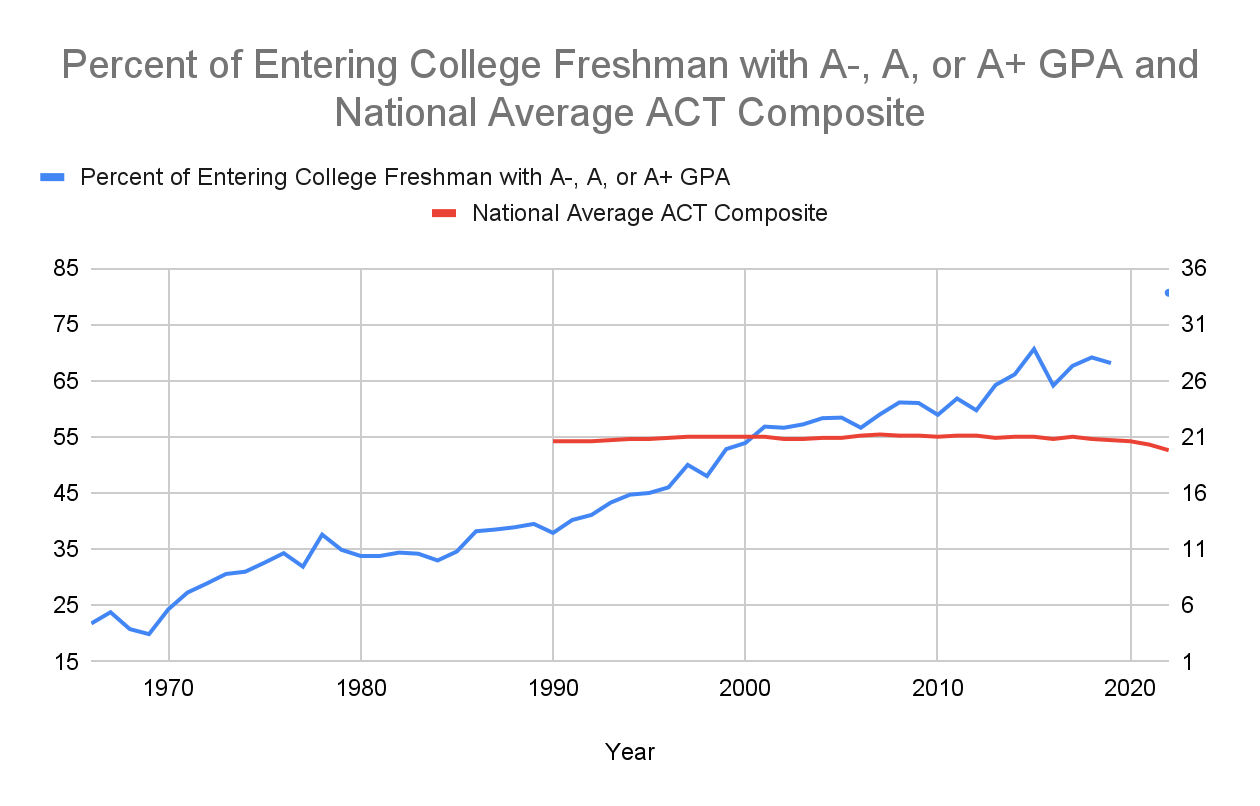
Grade inflation is real. According to the College Board, over 60% of college applicants in the class of 2021 obtained a 4.0 or better. According to ACT, Inc., grade point averages have risen over the last several years while ACT scores have fallen slightly.

According to the GPA data on over 18,000 college freshmen taken from the “American Freshman Survey,” an annual survey done by the Higher Education Research Institute at UCLA since 1966 (with 2 years missing due to the pandemic), a whopping 80.6% of entering college freshmen report an A average GPA in high school!

Bottom line: while it may be easier to apply, it is not easier to be admitted – at all.  

Should I send my test score?  Briefly, if your scores are additive to your application, you should send them.  If you’re not sure whether your scores are additive, you should probably still send them. Because of the increase in average test scores over the last couple of years, when comparing your score to a prospective university’s range, be sure to look at their ranges pre-pandemic.

According to data from the most recent admissions cycle, students applying with test scores were admitted up to 2.7 times as frequently as students who applied test optional! That’s a clear preference for applications for scores.

While students in the (pandemic) class of 2021 had significantly fewer testing opportunities, students in the class of 2023 have normal opportunities to test.  Selective colleges will expect and receive scores from most applicants.  Like many other “optional” pieces of a college application, the most competitive students will be submitting all the optional pieces, including test scores.

What does the future hold? I don’t have a crystal ball, but if Auburn, MIT, the University of Tennessee system, and Georgetown’s recent decisions are any indication, many test optional policies will continue to revert to test required. According to MIT, test scores help them more accurately assess a student’s readiness for their program.

MIT’s Dean of Admissions Stu Schmill said, “We are reinstating our requirement, rather than adopting a more flexible policy, to be transparent and equitable in our expectations. Our concern is that, without the compelling clarity of a requirement, some well-prepared applicants won’t take the tests, and we won’t have enough information to be confident in their academic readiness⁠ when they apply. We believe it will be more equitable⁠ if we require all applicants who take the tests to disclose their scores.”

In other words, top-tier colleges care about your test scores. They adopted test-optional policies so students who did not have the chance to take the exam due to Covid-19 could still apply. Data coming out (like from here) proves that test scores matter, and it’s possible that other schools will soon follow MIT’s lead in transparency and drop their test-optional policies. In fact, according to a survey by Ernst & Young and the Parthenon Group conducted in 2021, 20-30% of universities surveyed claimed they would likely move back to test-required policies within 3-5 years. Selective schools including Stanford have openly discussed their intent to once again require a college entrance exam score, and Yale has echoed MIT’s sentiments about the importance of test scores when making admissions decisions. 

Other schools, including University of Texas at Austin, University of North Carolina, and certain schools within the University System of Georgia announced a return to requiring college entrance exams and then shortly reversed their decisions. Remember, test-optional policies benefit the school, not often the student, and schools might be slow to relinquish their boost in ratings due to increased selectivity and average test scores. However, as universities continue to follow the path of MIT, it seems likely that more schools, especially those considered selective, will join this game of follow-the-leader.

So what to do? Due to uneven transcripts with uneven high school experiences and very real grade inflation, most college admissions staff view test scores as a known quantity that can validate your application.  A solid strategy is to work toward getting the best score you can but don’t send your scores right away.  Once you are ready to apply, you can decide if your scores help your application if you’re applying to a test-optional school.

As always, Woodlands Test Prep is here to help you through this process. Call us at 713-205-1807 for your free consultation, and we can discuss if test prep tutoring would help your student on their college journey. Remember, we teach; you relax!


Test Scores Can Help Win Merit Scholarships

Test Scores Can Help Win Merit Scholarships

From the Author

At Woodlands Test Prep, we understand that the cost of higher education can be a significant concern for students and their families. We believe that every student deserves access to the best educational opportunities, regardless of financial constraints. That’s why we’re passionate about sharing valuable information on how test scores can help unlock scholarships and pave the way to a brighter future. In this blog post, we’ll explore the impact of test scores on scholarships and provide guidance on maximizing your chances of securing financial aid.

The Power of Test Scores
When it comes to scholarships, test scores can be a game-changer. Many colleges and universities consider standardized test scores, such as the SAT or ACT, when awarding scholarships. These scores provide valuable insight into a student’s academic abilities and potential for success in higher education. By earning impressive test scores, you not only demonstrate your knowledge and skills but also position yourself for potential scholarship opportunities.

Merit-Based Scholarships
Merit-based scholarships are awarded to students based on their academic achievements, and strong test scores play a crucial role in qualifying for these prestigious awards. Admissions committees and scholarship providers recognize that exceptional scores reflect dedication, discipline, and the ability to excel academically. By investing time and effort in test preparation, you can significantly increase your chances of securing merit-based scholarships.

Here are some Texas-based colleges and scholarships that require or highly recommend test scores:

  • Sam Houston University: ACT 29 or SAT 1320 required. The Sam Houston Honors Scholarship is worth $10,000 annually.
  • Texas A&M: High ACT or SAT scores required. The Welch Scholarship varies in amount depending on financial need.
  • Texas Christian University: ACT 30-34 or SAT 1360-1500 recommended. The Founders’/TCU/Faculty/Dean’s/Chancelor’s Scholarships are worth from $12,000 per year to full-tuition.
  • Texas State University: ACT 32 or SAT 1420 recommended. The President’s Honor Scholarship is worth $12,000 per year.

Competitive Advantage
A high test score can give you a competitive edge over other scholarship applicants. When scholarship committees review applications, they often consider a combination of factors, including GPA, extracurricular activities, and personal achievements. However, outstanding test scores can make your application stand out from the crowd, demonstrating your commitment to academic excellence and potential for future success.


National Merit Scholarships
One of the most prestigious scholarship programs in the United States is the National Merit Scholarship Program. This program recognizes exceptional students who excel on the PSAT/NMSQT, a preliminary test taken during the junior year of high school. Students who achieve top scores on the PSAT/NMSQT may qualify as National Merit Semifinalists or Finalists, making them eligible for a range of scholarship opportunities. National Merit scholarships not only provide financial support but also carry significant prestige and recognition within the academic community. Be sure to check out this free and public resource of National Merit Scholarships offered at over 180 colleges (provided by Les Mathew from The Extra Mile College Admissions).

It’s worth noting that the typical Texas A&M National Merit Scholarship package is worth $42,000 over four years!

Maximizing Your Scholarship Potential
To maximize your scholarship potential, it’s essential to prioritize test preparation and aim for the highest scores possible. Here are a few tips to help you on your journey:

  1. Start Early: Begin your test preparation well in advance to allow ample time for study and practice. This will help you build confidence and achieve your target scores.
  2. Create a Study Plan: Develop a structured study plan tailored to your strengths and weaknesses. Utilize reliable test prep resources, practice exams, and seek guidance from experienced tutors or mentors.
  3. Practice, Practice, Practice: Regular practice is key to improving your test scores. Familiarize yourself with the test format, practice sample questions, and simulate test-day conditions to build your endurance and test-taking strategies.
  4. Seek Professional Guidance: Consider enrolling in a test prep course or working with a qualified tutor who can provide personalized guidance, strategies, and feedback to help you reach your full potential.
  5. Stay Motivated: Remember the bigger picture—your test scores can open doors to scholarships and educational opportunities that may shape your future. Stay motivated, maintain a positive mindset, and celebrate your progress along the way.

Your dreams of pursuing higher education should never be limited by financial constraints. By understanding the significance of test scores and their impact on scholarships, you can take proactive steps towards unlocking the funding you need. At Woodlands Test Prep, we’re here to support you on your journey, providing expert guidance, resources, and caring mentorship. Start preparing today, and open the door to a future filled with limitless possibilities. Together, we can make your educational dreams a reality.

Need Help Writing Your College Admissions Essay?

Need Help Writing Your College Admissions Essay?

From the Author

Writing a college essay can be a daunting task, but it is also an opportunity to showcase your personality, strengths, and passions to the admissions committee. Here are some key ideas to keep in mind when writing your college essay.

• Choose a topic that reflects your personality and experiences

One of the most important aspects of a college essay is the topic. The topic should reflect your personality and experiences. Admissions committees are looking for students who are unique and have a clear sense of self. Don’t be afraid to be creative and choose a topic that is not typical.  

Jennifer Howard, Woodlands Test Prep’s college essay coach says, “The most important part of the college essay process is taking the time to discover the strengths and stories that make you, you.”

• Use the essay to highlight your strengths and passions

Your college essay is an opportunity to highlight your strengths and passions. This is your chance to showcase what makes you stand out from other applicants. Use specific examples and anecdotes to illustrate your points and make your essay memorable.

“Remember,” Ms. Howard says, “you may think you don’t have anything interesting to write about because you haven’t invented the newest tech, won the state championship, or saved the world, but that couldn’t be farther from the truth.  In fact, it’s the little, everyday moments and perspectives that make an interesting essay and showcase your unique personality.”

• Focus on your personal growth and development

The college essay is not just about your past experiences but also about your future aspirations. Show how you have grown and developed as a person and how you plan to continue to do so in college and beyond. This will demonstrate to the admissions committee that you are a thoughtful and reflective individual.

• Use a clear and concise writing style

It is important to use a clear and concise writing style in your college essay. Avoid using jargon or overly complex language, as this can be off-putting to the reader. Instead, use simple and direct language to convey your ideas. Make sure to proofread your essay carefully for spelling and grammar errors.

• Show, don’t tell

Instead of simply stating that you are passionate about a particular topic or activity, show the reader through specific examples and anecdotes. This will make your essay more engaging and memorable.

• Be authentic and honest

Finally, it is important to be authentic and honest in your college essay. Don’t try to be someone you’re not or pretend to have experiences that you haven’t had. Admissions committees can usually spot insincerity and it can hurt your chances of being accepted.

Writing a college essay is an important and often challenging task, but it is also an opportunity to showcase your unique personality, strengths, and passions to the admissions committee. By choosing a topic that reflects your experiences, highlighting your personal growth and development, using a clear and concise writing style, showing rather than telling, and being authentic and honest, you can create a compelling essay that sets you apart from other applicants.

According to Ms. Howard, “The college essay is the part of your application that makes you more than a GPA, test score, or list of accomplishments–it makes you human. Don’t waste that opportunity.”

Join Jennifer Howard this summer in our College Essay Workshop, so she can help you bring out your unique qualities to best showcase YOU!

At Woodlands Test Prep, we teach, so you can relax.

The Digital SAT: A Brave, New Frontier

The Digital SAT: A Brave, New Frontier

From the Author News Tests

Revised February 1, 2023

Visit our new Digital Adaptive SAT Page with ALL the scoop you need.

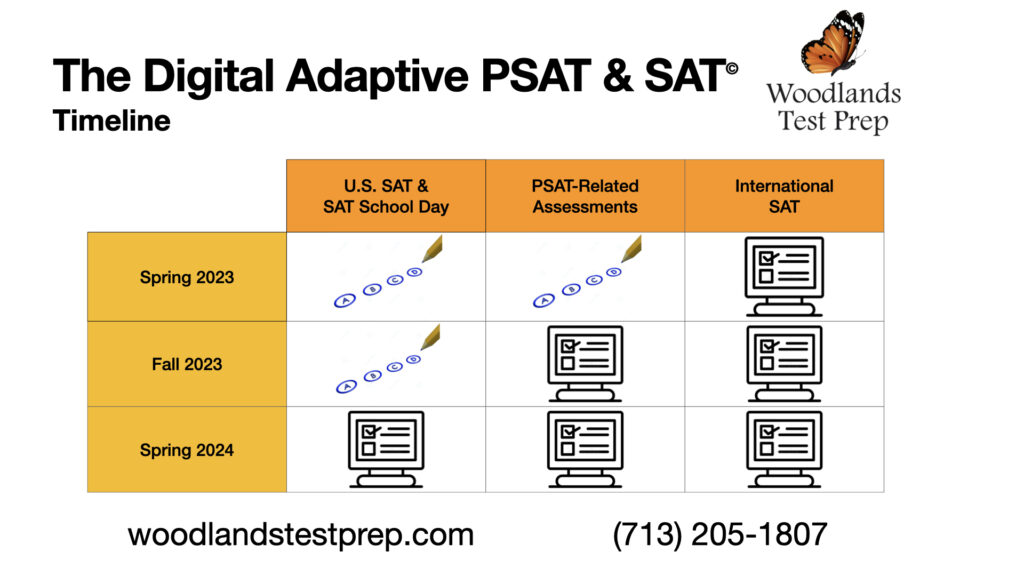
The College Board announced that the SAT will be going digital in March 2024, and the PSAT will be going digital in October 2023.  As if *that* isn’t big enough news, they are also changing the format substantively to be more student-friendly.

Update: The first widely available practice tests are available! Click here to download the app and check out the new format!

So What’s Changing?

Structure:

  • Same scoring format, still on 1600 scale
  • Shorter overall test time – approximately 2 hours instead of 3.25 hours
  • Adaptive scoring – performance on the first section of topic affects the difficulty of the second section
  • Much more time per question
  • No more long reading passages
  • Built in Desmos graphing calculator for ALL math questions

Logistics:

  • Moving to an all-digital format – bring your own device or use one of the College Board’s
  • Students will still test at a testing center
  • Students will install the testing app prior to testing day
  • Digital PSAT will be much the same as the Digital SAT in structure
  • Much faster score receipt – in days rather than weeks
  • Accommodations will be handled in the digital environment
  • National test dates will remain unchanged; many more choices for School Day dates

Overall, the changes are good for students!


When Is All This Happening?

First up, the PSAT will be Digital Adaptive in 2023 – this coming fall! Then, the regular SAT will switch completely to the Digital Adaptive format in March 2024. The Class of 2025 – this year’s sophomores – have several choices to make.


What Does That Mean For My High School Student?

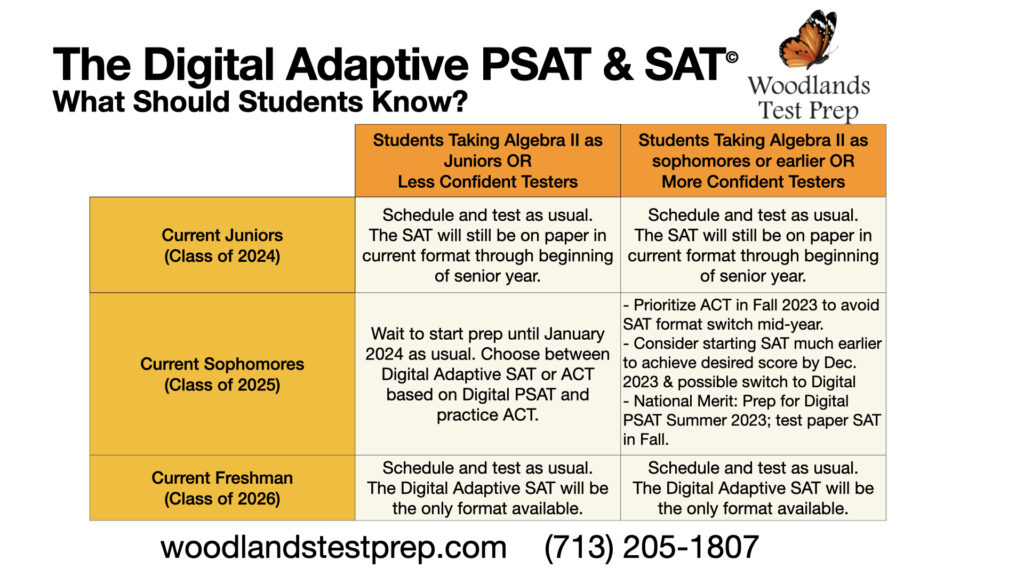
If you are a junior this year (Class of 2024), you won’t see any changes. Just keep on doing your thing!

If you are a sophomore this year (Class of 2025), this change affects you significantly. See the table below for options, and contact us to schedule a free consultation to help you navigate these changes.

Note: If you are aiming for National Merit in 2023, prepping will be more complicated due to the switch. We are ready to help you navigate the new format with confidence!

If you are a freshman this year (Class of 2026) or younger, this will all be old news by the time you get there. You’ll be able to choose between paper ACT and Digital Adaptive SAT.


As always, Woodlands Test Prep is on top of the change to the Digital Adaptive PSAT and SAT. We look forward to helping with all your questions!

Not Just One College Ranking to Rule Them All

Not Just One College Ranking to Rule Them All

From the Author Uncategorized

Every summer, the well-known U.S. News and World Report releases its U.S. News Best Colleges List, ranking more than 11,500 schools, each vying for as close as they can get to that #1 spot. Students and parents hurry to see which schools made it into the top ten, hoping to start sending their college applications and essays to the schools highest on the list. However, college ranking lists are not like The Lord of the Rings: There is no one ring, or list, to rule them all. There are, in fact, many different college rankings.  Depending on your priorities, different rankings help to see other facets of those college application choices.

As one of the oldest ranking systems, U.S. News and World Report is the most famous vehicle that families use to decide which schools are the “top schools.” However, what students and parents should realize is that there are actually many ranking lists out there, and they all have different methods of ranking schools. You can explore multiple ranking systems to tell you what are the best schools for the criteria they’re measuring. To get started, you and your child need to ask yourself, “What matters most to ME for my college experience?” You might consider a specific major, student outcomes and success, affordability, cultural aspects such as sports or art programs, and many more. 

So what is U.S. News Best Colleges really telling you?

U.S. News Best Colleges considers a multitude of factors. They consider graduation and acceptance rates, class sizes, GPA and test scores of students, student debt after graduation: all categories you might expect. However, one unique category is called “peer opinion.” This category accounts for 20% of a college’s overall score. What is peer opinion? U.S. News asks the president, provost, and dean of admissions of each school to rank other schools on a scale of 1-5. The higher opinion they have of that school, the higher up the list the school goes. This ranking system means that the same ancient ivy leagues and selective schools remain at the top: everyone’s heard of them and knows them to be a “good” school. Therefore, if you’re only looking at this one list, you’re really looking at prestige.

If prestige is not what matters most to you, it’s time to begin the important process of thinking about who you are and why you’re going to college. Search for college ranking lists that prioritize the same criteria that are important to you. Below are a few lists we recommend and what you can find out from reviewing them.

Academic Influence

Created by data scientists, this website ranks thousands of universities using a program they have dubbed the InfluenceRanking engine. Their goal is to create lists that are as unbiased and ungameable as possible, so you can make an informed decision about where to go to school based on your likelihood of success, along with other criteria you can filter for such as major, online programs, and affordability. Academic Influence measures what they consider “influence”: How many students graduate from that college who go on to have influential careers in their fields, and how influential are they? If your main focus is post-graduate success in your field of study, this may be the ranking system for you.

Niche

Niche ranks based on recommendation: What are real people saying about the colleges and universities they’ve attended? They rank schools using millions of ratings, reviews, and surveys. Along with general rankings, they have some unique categories that might help you determine the best school based on what’s important to you, such as best athletic programs, social scenes, or campuses. You can also filter based on the major you’re interested in. Start with this list if your most important criteria is the college experience.

Colleges That Change Lives

CTCL is a nonprofit organization that helps students to consider more than the big, selective schools. They coach students on how to find a school that fits them with questions to ask and topics to consider. Their brochure “How to Choose a College That’s Right for You” is a great place to start if you don’t know what you’re looking for. They also have resources for senior year anxiety and how to make the most of your campus college visit. CTCL member colleges are small liberal arts colleges and universities with holistic admissions processes, challenging and supported academics, residential communities, and schools that offer aid to make learning more affordable.

(Edit added 4/20/2023) New York Times

The New York Times recently published an article pointing out the variety of criteria that a student might base his or her college decision on along with a meta-list creation tool. You can weight a lot of different factors to see how your list might change. It’s dynamic and pretty fun!

What’s the bottom line?

There is no one list to rule them all. U.S. News Best Colleges’ ranking system is the best known, but it is not the only college ranking system out there. Find out what is important to you and make that criteria the center of your college search.

Unpacking the PSAT and Change to Digital SAT Seminar

Unpacking the PSAT and Change to Digital SAT Seminar

Uncategorized

Wondering what your PSAT scores mean? Watch our seminar from December 8th to learn more about your PSAT scores and what they mean.  We also discussed the switch to the Digital PSAT coming up next year! Finally, we touched on how you might be able to become a National Merit Scholar. Click here to learn more about when and how your PSAT scores will be available.

Watch the seminar here

Download the presentation with our notes here

Woodlands Test Prep celebrates 10 years of helping students achieve their test best

Woodlands Test Prep celebrates 10 years of helping students achieve their test best

News

Woodlands Test Prep is celebrating its 10-year anniversary in 2022!  Growing from a solo tutoring practice to a full-service educational services company, Woodlands Test Prep has carefully put together a full set of tutoring services, including test prep for the SAT, PSAT, and ACT and academic and AP tutoring for math, science, history, language arts, and foreign language subjects.  

We sat down with Susan to talk about her ten years in business: how her company was created and how it has impacted The Woodlands community.  What originally began as a small side hustle has ended up becoming one of the most influential tutoring services in The Woodlands.  

Meet the Founder

Susan started tutoring in 1995 as a hobby. When asked what drew her to tutoring, she said: 

“I’ve always loved standardized tests. I just think they’re fun. Even as a kid, I thought they were fun. So I’ve obviously always been a little bit weird ha ha!”

Indeed! This “weird” love for tests made Susan an engaging tutor, which she found was exactly what students needed to succeed. After taking a break from teaching SAT and GMAT classes in order to raise children, she was ready for a side hustle and realized that what had been her fun hobby could become her business. Susan said:

I asked myself, what do I like doing? And I thought, okay, I like tests.  Then I started Woodlands Test Prep, and it honestly grew far beyond any expectations I ever had. Pretty soon I had a number of tutors working for me and was doing practice tests for the library and for schools here in the area. It’s been a joy from the beginning.”

It’s obvious that she and her team of tutors not only have fun teaching students how to succeed on their college entrance exams but are experts in the field of test prep as well. Over the past several years, Susan’s average scores have been a 1580 on the SAT and a 35 on the ACT, and she only hires tutors who show a similar affinity for these tests. With a love for tests and tutoring and Susan’s honed curriculum, she and her team of expert tutors are ready to help any student succeed. 

To stay up-to-date, Susan is an active member of the NTPA (National Test Prep Association), where she collaborates with other test prep professionals.  She also was featured on the podcast Tests and the Rest on episode 231. All this professional development is passed on to her tutors and also shared via her blog on Woodlands Test Prep’s website. You can read expert information along with Susan’s professional thoughts and opinions on everything from the new digital SAT to what test optional really means for your student.

About Woodlands Test Prep and Its Services

Woodlands Test Prep is experienced in helping every student meet their greatest potential.  Taking the SAT, ACT, or PSAT is a skill that can be learned and polished. Whether your student needs help with math, science, language arts, or social studies, they can help.  No matter where your student is starting, focused test preparation and academic tutoring helps not only improve a student’s score or grades, but also their confidence.  Susan commented: 

“Our team of tutors is really without peer.  I feel so lucky to have each and every person on the team.  Only tutors with both heart and serious academic chops make the cut to join our team.  Each tutor is genuinely an expert in the topic or skills he or she is teaching, besides just being a ton of fun to be around.”

They provide customized test preparation several ways: one-on-one in-home tutoring, small class format, and proctored practice tests. Working this way allows them to uniquely target your student’s needs.  They provide proven, successful strategies and skills. Plus, they identify and polish any test content areas that need attention.

For high-achieving students, they offer a “Goal 1600 Class” each summer designed to push them even further. In the last five years, 25 of their students went on to become National Merit Semi-Finalists!

Test prep tutoring is an investment in your student’s future, but it is also a financial investment that can have a significant return. Not only can it help students get the score they need to get into college, but it can open doors for grants and scholarships that might have been previously closed. Here’s what one mom had to say about it:

My daughter took one-on-one tutoring this summer to raise her ACT score to get accepted to A&M. She met with an amazing tutor once a week who coached her, and then she also took the practice tests available through your organization before taking the ACT a second time. Thanks to her score, as well as other aspects of her application, she is now going to be Texas A&M Class of 2026! 

The return on investment was outstanding, as her backup school was offering her $3,000/year renewable for four years due to her ACT score and her class rank. For anyone wondering if your service is worth the cost, please let them know it was for us.

If your student needs support for academic success or if college is a part of your student’s future, Woodlands Test Prep is just what your student needs to succeed. Call them today to learn how they fit into your child’s journey to college and beyond.

Click here to learn more about Woodlands Test Prep or call (713) 205-1807 to set up a session today!

Tests and the Rest Podcast

Tests and the Rest Podcast

From the Author Podcast

Woodlands Test Prep’s founder and CEO, Susan Powers, was recently featured on Tests and the Rest podcast, a podcast devoted to the college admissions process. Tests and the Rest hosts Mike and Amy said Woodlands Test Prep “improves students’ scores, supports students’ academic success, and helps families navigate the college admissions testing process with much less stress.”