Changes are coming to ACT!

Changes are coming to ACT!

From the Author SAT vs. ACT Tests

Updated July 8, 2025

Just when you thought it was safe to go into the water, now that the Digital PSAT and SAT are old news, here comes ACT with changes of its own!

Our hot take:

  • Students will appreciate – strike that – love that the ACT is shorter and has more time per question.
  • In the near term, selective colleges will likely require Science. Plan to still take Science.
  • So much uncertainty!  We’re buckling up for a bumpy ride with ACT until at least January 2026.

Here’s the short summary on what’s changing and when. (Click here for WAY more details!)

What’s Changing?

  • Significantly more time per question.
    • English and Math questions get 12% and 17% more time, respectively.
    • Reading and Science questions get 28% and 27% more time, respectively.
    • Shorter passages —> less text to process.
  • Science is OPTIONAL.
  • Shorter overall timing for the test, especially if the student opts out of the Science section —> now shorter than the Digital SAT timing!
  • Experimental questions (formerly Section 5) will now be part of the regular sections: reduces overall testing time AND improves data.
  • Composite scores will now be calculated ONLY on the English, Math, and Reading scores.

What’s NOT Changing?

  • Scoring will remain the same: each section ranges from 1 – 36 and the composite is an average of the English, Math, and Reading sections.
  • Students can choose between paper and digital formats. ONLY take paper. Click here for why!
  • Writing is still optional.
  • Students will still NOT be able to use their own device for digital testing (BUT that is coming soon).

When is this happening?

  • The changes above were introduced first in April 2025 in the digital format ONLY.
  • The changes above will be incorporated into PAPER beginning in September 2025.
  • The changes will be incorporated into School Day testing in “Spring 2026.”

Our current recommendations by class year:

  • Seniors (Class of 2026)
    • If you took the old format of the ACT, the new one will have different pacing, and math will feel much different. Be SURE to only take the ACT on paper. Note that once you take the “enhanced” format, your composite and superscore will ONLY be calculated based on your English, Math, and Reading scores.
  • Juniors (Class of 2027)
    • Still consider the ACT by taking a practice test of both SAT and ACT. Evaluate the impact of the availability of practice materials (essentially no new materials in new format). Students for whom the ACT may still be the better choice for Fall 2025 testing are:
      • Students whose practice tests scores for the ACT are significantly better than their SAT practice scores.
      • Below-average scoring students whose ACT and SAT practice scores are equal.
      • Below-average scoring students who have extra time accommodations for the ACT.
    • Plan to take Science.
    • Do NOT take the digital version of the ACT.
  • Sophomores (Class of 2028)
    • Wait and see.  We will learn a lot between now and when you need to start making choices on which test to take.

Want to see how the new “enhanced” format ACT or the SAT works for you? Try taking one at home! If you’d like to see how these changes might or might not mean anything for you, please let us know. We love helping families develop a testing plan. Always at no charge.

Perspectives on the Digital SAT

Perspectives on the Digital SAT

Digital SAT Tests

Susan Powers, our Founder, recently served on an industry expert panel about the Digital SAT at the National Test Prep Association’s Winter Conference in New Orleans, Louisiana on December 13th. The panel included Mike Bergin – Chair of the Board of the National Test Prep Association, co-host of the popular college admissions podcast Test and the Rest, and President and Owner of Chariot Learning based in Rochester, New York; Lori Tofexis – SAT curriculum expert and Owner of Circle Test Prep based in Hollywood, Florida; and Brenna O’Neill (moderator) – President of Test Innovators, a leader in digital test preparation curriculum.

Below are a few of the important takeaways from the industry panel.

  1. Desmos is changing the way students will approach the math modules. It is the biggest change in decades.

2. But the biggest changes on the Digital SAT lie in the verbal modules. Check out how the verbal modules are structured and what that means for how you need to allocate your time!

Here at Woodlands Test Prep, we’ve been preparing for the Digital SAT for the last year: analyzing every aspect, building a world-class curriculum, and finding the best ways for students to approach it. We’re here to share what we’ve learned with you!

How to Choose Between the Digital SAT and ACT?

How to Choose Between the Digital SAT and ACT?

From the Author SAT vs. ACT

Now that college admissions is moving back into more of a test-preferred environment, students don’t have to struggle with the choice of whether or not to take a college entrance exam but rather which one. In a recent industry podcast, Test and the Rest: The College Admissions Industry Podcast, Woodlands Test Prep Founder Susan Powers weighs in on the important factors in choosing between the digital SAT and the ACT.
What are five things you will learn in this episode?

  1. Why should students give thought to which test they want to take?
  2. How are the ACT and digital SAT different?
  3. How does the ACT Science section play into a decision about which test to take?
  4. Should you prepare for both the ACT and digital SAT?
  5. Are there any general rules for what types of students are better suited to either test?
Congratulations Class of 2024 National Merit Semifinalists

Congratulations Class of 2024 National Merit Semifinalists

Classes From the Author

Woodlands Test Prep congratulates all students who have achieved Semifinalist status in the 2024 National Merit Scholarship Program.  All of these students have worked hard to reach the top levels of the scholarship program.  The Company especially congratulates the SIX students with whom it has worked with as they prepared for this scholarship competition including Jacob Daniels, Claire Jones, Vikram Kansal, Brooks McCoy, Daniel Milan, and Ryan Taylor.  Semifinalists will go on to compete for Finalist standing, and from there, become National Merit Scholars.  Woodlands Test Prep wishes these students all the best as they continue on in the competition.

The National Merit Scholarship Program honors individual students who show exceptional academic ability and potential for success in rigorous college studies.

Woodlands Test Prep hosts a “Goal 1600” class each summer to help National Merit hopeful students to prepare for their junior year PSAT.

Woodlands Test Prep, a Texas-based company, was founded in 2011 to help students and their families reach their potential on college admissions tests.  The Company has helped over 35 students over the last seven years achieve Semifinalist status.  The Company believes that taking these tests is a skill that can be learned and honed.  Woodlands Test Prep provides tutoring for academic subjects (all levels of math, science, history, and language arts) as well as the PSAT, SAT, ACT, SSAT, and ISEE in both a one-on-one setting and in a small class setting.  The Company’s philosophy can be summed up as “We teach. You Relax.”

The Truth About ‘Test Optional’

The Truth About ‘Test Optional’

From the Author

Test Optional: Does that mean I can skip taking the SAT or ACT?

Nope.  While it may be easier to apply, it is NOT easier to get in – at all.

Let’s break down this topic into some manageable chunks.

• What does a “test optional” policy mean?  It means that schools don’t require test scores for a complete application.  This is in contrast to a “test blind” application policy such as that used by the University of California system and California State University system. These schools will specifically not consider your test scores even if you send them. 

During the pandemic, most colleges announced a change in their application policies for the class of 2021 to a test optional policy because most students had no access to testing opportunities.  Many colleges extended that policy to the class of 2022. However, the University of Tennessee system, Auburn, MIT, and Georgetown have announced that future classes will need to submit scores with their applications, and many other colleges (in Florida, Georgia, and Tennessee in particular) have already returned to (or never stopped) requiring scores so be prepared for more colleges to follow suit.  You can check the policy of the colleges you’re interested in here.

• What happens when a college goes test optional?  Colleges experience at least two changes when they go test optional: average test scores rise and admission rates decrease.  Average test scores rise because students who are lower-scoring do not report their scores, so the overall average rises for the incoming class.  Admission rates fall because students (incorrectly) perceive that it is easier to be accepted and more students apply while the number admitted stays the same. 

These effects were seen again during the 2022 application cycle.  The most selective colleges in the U.S. saw enormous (sometimes even double!) increases in applications from pre-pandemic levels. 

Both of these changes benefit the college, NOT the student.  In some cases, students also benefit from these policies, although that isn’t clear overall.  While test optional does create a new avenue for students who truly struggle with standardized testing; schools clearly value test scores as a validation of grades and transcripts. 

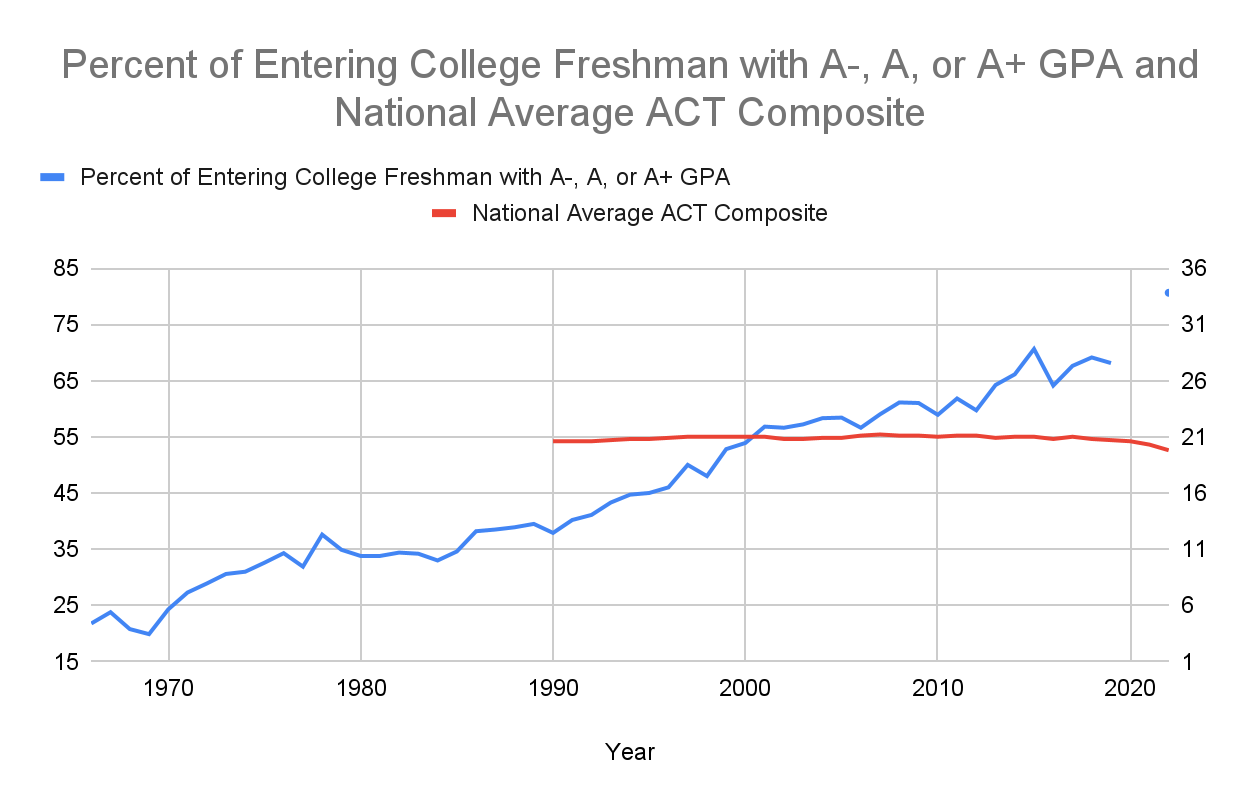
Grade inflation is real. According to the College Board, over 60% of college applicants in the class of 2021 obtained a 4.0 or better. According to ACT, Inc., grade point averages have risen over the last several years while ACT scores have fallen slightly.

According to the GPA data on over 18,000 college freshmen taken from the “American Freshman Survey,” an annual survey done by the Higher Education Research Institute at UCLA since 1966 (with 2 years missing due to the pandemic), a whopping 80.6% of entering college freshmen report an A average GPA in high school!

Bottom line: while it may be easier to apply, it is not easier to be admitted – at all.  

• Should I send my test score?  Briefly, if your scores are additive to your application, you should send them.  If you’re not sure whether your scores are additive, you should probably still send them. Because of the increase in average test scores over the last couple of years, when comparing your score to a prospective university’s range, be sure to look at their ranges pre-pandemic.

According to data from the most recent admissions cycle, students applying with test scores were admitted up to 2.7 times as frequently as students who applied test optional! That’s a clear preference for applications for scores.

While students in the (pandemic) class of 2021 had significantly fewer testing opportunities, students in the class of 2023 have normal opportunities to test.  Selective colleges will expect and receive scores from most applicants.  Like many other “optional” pieces of a college application, the most competitive students will be submitting all the optional pieces, including test scores.

• What does the future hold? I don’t have a crystal ball, but if Auburn, MIT, the University of Tennessee system, and Georgetown’s recent decisions are any indication, many test optional policies will continue to revert to test required. According to MIT, test scores help them more accurately assess a student’s readiness for their program.

MIT’s Dean of Admissions Stu Schmill said, “We are reinstating our requirement, rather than adopting a more flexible policy, to be transparent and equitable in our expectations. Our concern is that, without the compelling clarity of a requirement, some well-prepared applicants won’t take the tests, and we won’t have enough information to be confident in their academic readiness⁠ when they apply. We believe it will be more equitable⁠ if we require all applicants who take the tests to disclose their scores.”

In other words, top-tier colleges care about your test scores. They adopted test-optional policies so students who did not have the chance to take the exam due to Covid-19 could still apply. Data coming out (like from here) proves that test scores matter, and it’s possible that other schools will soon follow MIT’s lead in transparency and drop their test-optional policies. In fact, according to a survey by Ernst & Young and the Parthenon Group conducted in 2021, 20-30% of universities surveyed claimed they would likely move back to test-required policies within 3-5 years. Selective schools including Stanford have openly discussed their intent to once again require a college entrance exam score, and Yale has echoed MIT’s sentiments about the importance of test scores when making admissions decisions. 

Other schools, including University of Texas at Austin, University of North Carolina, and certain schools within the University System of Georgia announced a return to requiring college entrance exams and then shortly reversed their decisions. Remember, test-optional policies benefit the school, not often the student, and schools might be slow to relinquish their boost in ratings due to increased selectivity and average test scores. However, as universities continue to follow the path of MIT, it seems likely that more schools, especially those considered selective, will join this game of follow-the-leader.

• So what to do? Due to uneven transcripts with uneven high school experiences and very real grade inflation, most college admissions staff view test scores as a known quantity that can validate your application.  A solid strategy is to work toward getting the best score you can but don’t send your scores right away.  Once you are ready to apply, you can decide if your scores help your application if you’re applying to a test-optional school.

As always, Woodlands Test Prep is here to help you through this process. Call us at 713-205-1807 for your free consultation, and we can discuss if test prep tutoring would help your student on their college journey. Remember, we teach; you relax!

Load more

No more posts to load.

Load more

No more posts to load.