Hot Takes on the October 2025 ACT and What Moving Forward Looks Like

Hot Takes on the October 2025 ACT and What Moving Forward Looks Like

Daily Notes From the Author SAT vs. ACT Tests

Something wonderful happened! One month ago, ACT, Inc. announced a partnership with the National Test Prep Association (NTPA – of which Woodlands Test Prep is a Founding Member, and I am a Board member) such that NTPA members are now – finally! – allowed to test on all national test dates. We are so excited for this opportunity! We are also an official ACT Affiliate, which means that we can legally and freely use official ACT materials in our test prep practice. We are very honored! 

Four members of our team and I took the October 18th test: three on paper and two digitally using the Bring Your Own Device platform. We tested at three different test centers. Our experiences, combined with my NTPA colleagues’ experiences gathered on Zoom to informally debrief from their testing experiences this past Saturday help form Woodlands Test Prep’s impressions of this new test format. Wanna know how we did? Check it out here!

Our hot takes from this weekend’s testing

Who should consider the ACT now?

  • For prep starting in January 2026, we revert to our previous guidance that all students should take a mock ACT and a mock SAT (or use their PSAT) scores to determine on which test they are naturally higher-scoring.
  • Students with extra time accommodations or students who are scoring below median (and certainly below SAT 1000) often can move their ACT score to a higher level than an SAT score.
  • Students for whom the SAT verbal section is a particular challenge can also frequently move their ACT English and Reading scores to a higher level than their SAT verbal score because of the lower complexity of the ACT verbal sections.

Time pressure: While we expected the test to feel significantly less time-pressured, it didn’t feel measurably so.  

  • The shift in English from 60% grammar (fast) to 60% reading analysis (slower) meant that what one hand gave, the other hand – for the most part – took away. 
  • Math’s change from 60 questions to 45 questions means the difficulty level ramps up almost from the get-go.  Talking in big, round numbers, ACT essentially eliminated 15 easy questions, meaning the remaining questions take longer and the “rare” topics will be a bigger deal.  Again, structurally there is more time per question but that time is needed.
  • Reading got the most “more time per question” in the move to the enhanced ACT and did, in fact, feel **slightly** less time pressed. That being said, there are measurably fewer “direct evidence” questions (go find the thing in the passage and find the answer that matches it word for word), so the mix of questions takes longer overall.
  • Science had the most diverse set of opinions about the depth of change and how that affected timing. Stay tuned once we get the test questions in a few weeks. We all agreed that more “outside knowledge” was required and that there were more “mathy” questions that required a calculation or two.

Digital versus Paper: Paper is far superior. Can confirm. See our blog post for all the details we still stand behind.

  • Bottom line: ACT is NOT suited to the digital format with long passages and graphs to reference. The online tools are NOT set up to overcome that hurdle.
  • While our two tutors had a smooth digital experience, MANY students around the country did not. Reddit is full of technical horror stories from the weekend.
  • Desmos will be integrated into the Saturday testing system during this school year. That integration WILL NOT overcome the inherent other problems with taking the ACT in a digital format. So don’t stay tuned for that!

Variability: Fewer scored items – on some sections, *dramatically* fewer items – necessarily means more variability in section scores and composite scores.

  • A couple of “careless mistakes” (what we would call “process errors”) can make a much bigger difference, particularly at the top of the scoring scale.
  • One potential outcome is that testing more than 2 – 3 times if your target schools superscore may allow the student to take advantage of that variability.
  • The dearth of enhanced ACT practice material fully reflecting the tests that students (and tutors!) are actually seeing is a problem.  It’s hard to be fully prepared if you don’t have adequate materials to do so. Not enough preparation material leads to more variability. Adequate materials are a short-term issue though.

The testing process was smooth-ish here locally BUT….

  • Test center coordinators and proctors aren’t stoked about all the options; those options make their jobs more confusing. 
  • Students with science/no science and writing/no writing were all mixed together in one room.  Most of us had proctors who were confused (therefore making the students confused) about processes. Students getting up at various times to leave when their sections were completed felt disruptive.
  • Writing the end time on the board and having a clock available for paper testers does not appear to be part of the test center requirements or proctor script.  Students will need to be prepared for this. It even reduced the performance of many professional tutors who are completely prepared for the test.
  • All the digital/paper choices mean that students end up with fewer test center options in a particular driving radius because schools must essentially choose to be paper or digital, but not both. Some of us drove 45 minutes!
  • Almost all students took Science at all locations.  Other regions around the country reported similar experiences. Over half of the students at my location, though, also took writing! (Yikes!) But that doesn’t seem to be true at the other two local locations or around the country.

We are hard at work fine-tuning our curriculum to target the new test format and question proportions on the enhanced ACT. #nerdalert 🤓  We’re excited!!  

We plan to continue to have at least one member of the team test at each available test date so that we can monitor the evolution of this new format in real time.

We’re looking forward to talking with you about the changes and what they mean for your students! Let us know how we can help!

When Should I Start Test Prep?

When Should I Start Test Prep?

Uncategorized

The return of PSAT scores in November gets lots of families thinking about college admissions testing. Deciding on when to start taking the SAT or ACT is an individualized decision. Many factors can influence when to start.

If your student is a sophomore or younger, you have time. The earliest that students should start testing is early in their junior year, making summer between sophomore and junior year the perfect time to prep for those students.

If your student is a junior and hasn’t yet set up a testing plan, now is the time.

Let’s start with what you should consider.

  • Math level: What math class you take as a sophomore is the most important factor in deciding when to start testing. Both the SAT and ACT cover math up through Algebra II. Students who take Algebra II as sophomores can start testing in the fall of their junior year. Students who take Algebra II as juniors will benefit from waiting to start testing in the spring so they have a more solid foundation in Algebra II.
  • Schedule: Essentially all students will take the SAT or ACT multiple times. Test prep takes time; students are learning mostly learning new skills, rather than new content. Students should prep for every “on the record” administration, so they should plan to do the most prep before their first test date. We suggest allowing at least 8 weeks prior to your first test date to get ready. Therefore, aim for your first test date when you’ll have a less busy time for the couple of months prior to your first test date, balancing with keeping plenty of room for re-testing dates.

Typical testing schedules include:

  • Summer prep/fall test dates:
    • Students who have completed Algebra II as sophomores and who have (relatively) lighter schedules in the fall can start prepping in the summer and take either the August SAT or September ACT dates, leaving room for subsequent re-testing dates in the fall.
    • If you or your student plays football, is a cheerleader, or marches in marching band, this schedule might not work for you because fall is exceptionally busy.
    • If you or your student is aiming for National Merit recognition, you MUST plan to prep for the SAT over the summer. The PSAT and SAT are essentially the same thing. You’ll prep over the summer, take the August and October SAT dates and take the October PSAT which serves as the criteria to advance in the scholarship competition. We focus on National Merit preparation in the summer; check out our Goal 1600 class if you are interested.
  • Winter prep/spring test dates:
    • Students who are taking Algebra II as juniors can start prep right after the holidays, aiming for either the March SAT or April ACT date.
    • Students who took Algebra II as sophomores but were too busy at the beginning of the fall semester can start prepping a bit earlier, say November, for the February ACT if the ACT is a better fit for them. (Want more advice on how to choose? See our blog post here.)
    • If your starting prep in the winter, be sure to leave enough time for re-testing. Early Decision and Early Admission deadlines are typically November 1st of a student’s senior year, so test dates up through August and October for the SAT and September and (sometimes) October for the ACT are also opportunities to re-test.

What if I’m a freshman/sophomore (or my student is a freshman/sophomore), and I really really want to do something this year? Here are some great ideas!

  • Focus on grades. It will be much easier to raise your SAT or ACT score in a (relatively) short period of time versus changing your GPA or class rank by the time you get to the end of junior year. You will apply to college on a 6-semester transcript, so freshman and sophomore year grades matter.
  • Focus on getting super solid on grammar rules (comma rules are surprisingly strict and few in number), math content, and reading comprehension skills. The SAT and ACT test things that everyone has learned; there’s really nothing new content-wise. Take the opportunity to get confident with the material while you’re learning it.
  • Focus on non-fiction, higher-level reading. Many Language Arts classes emphasize fiction rather than non-fiction; whereas the SAT and ACT test almost exclusively non-fiction writing. Use freshman and sophomore years to develop a regular non-fiction reading practice. We’ve even created a great list of online periodicals to choose from! Your phone is already in your hand so let’s read something good!

We’re always happy to set up a free consultation to help you think through your testing plan. Let us know how we can help!

Changes are coming to ACT!

Changes are coming to ACT!

From the Author SAT vs. ACT Tests

Updated July 8, 2025

Just when you thought it was safe to go into the water, now that the Digital PSAT and SAT are old news, here comes ACT with changes of its own!

Our hot take:

  • Students will appreciate – strike that – love that the ACT is shorter and has more time per question.
  • In the near term, selective colleges will likely require Science. Plan to still take Science.
  • So much uncertainty!  We’re buckling up for a bumpy ride with ACT until at least January 2026.

Here’s the short summary on what’s changing and when. (Click here for WAY more details!)

What’s Changing?

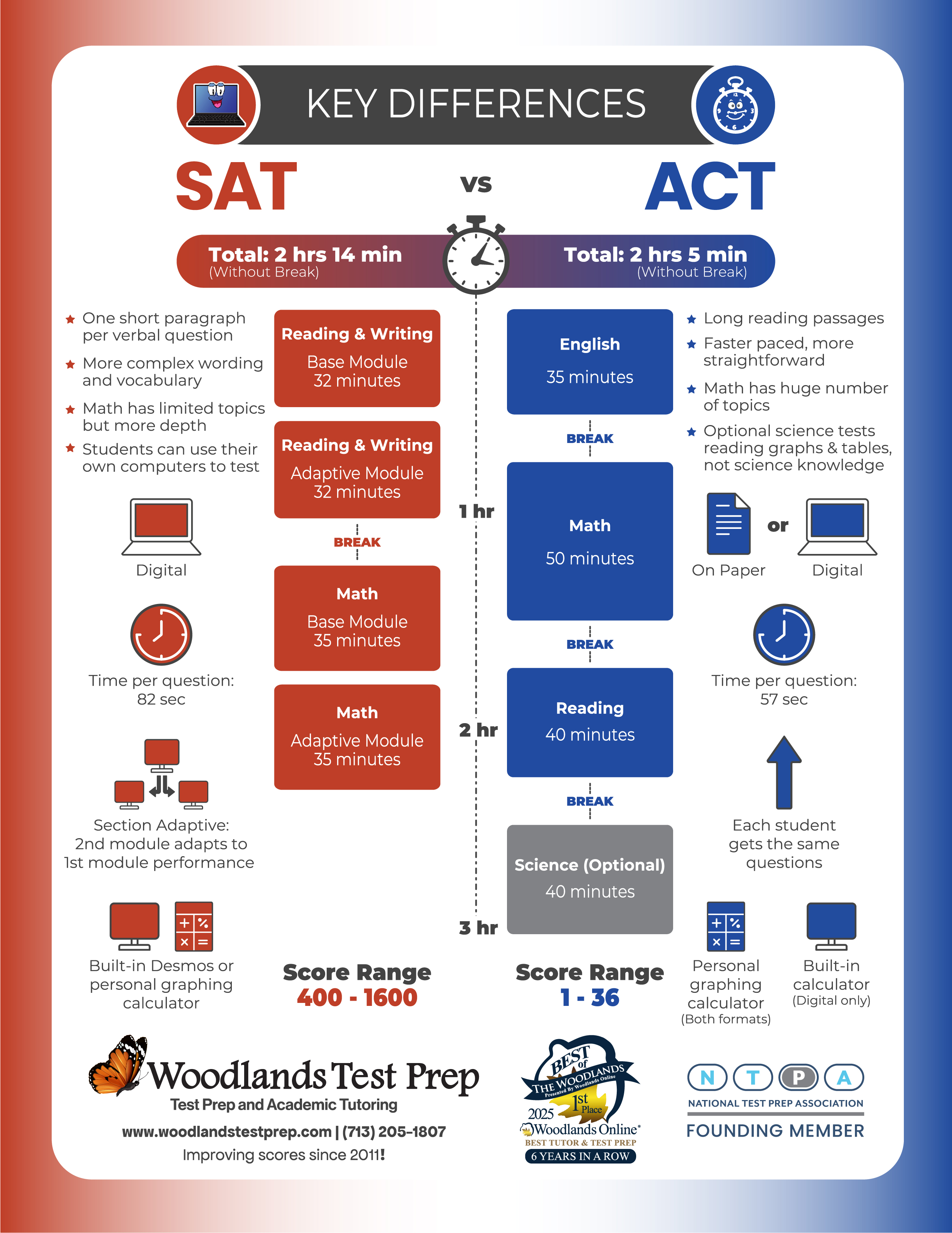
  • Significantly more time per question.
    • English and Math questions get 12% and 17% more time, respectively.
    • Reading and Science questions get 28% and 27% more time, respectively.
    • Shorter passages —> less text to process.
  • Science is OPTIONAL.
  • Shorter overall timing for the test, especially if the student opts out of the Science section —> now shorter than the Digital SAT timing!
  • Experimental questions (formerly Section 5) will now be part of the regular sections: reduces overall testing time AND improves data.
  • Composite scores will now be calculated ONLY on the English, Math, and Reading scores.

What’s NOT Changing?

  • Scoring will remain the same: each section ranges from 1 – 36 and the composite is an average of the English, Math, and Reading sections.
  • Students can choose between paper and digital formats. ONLY take paper. Click here for why!
  • Writing is still optional.
  • Students will still NOT be able to use their own device for digital testing (BUT that is coming soon).

When is this happening?

  • The changes above were introduced first in April 2025 in the digital format ONLY.
  • The changes above will be incorporated into PAPER beginning in September 2025.
  • The changes will be incorporated into School Day testing in “Spring 2026.”

Our current recommendations by class year:

  • Seniors (Class of 2026)
    • If you took the old format of the ACT, the new one will have different pacing, and math will feel much different. Be SURE to only take the ACT on paper. Note that once you take the “enhanced” format, your composite and superscore will ONLY be calculated based on your English, Math, and Reading scores.
  • Juniors (Class of 2027)
    • Still consider the ACT by taking a practice test of both SAT and ACT. Evaluate the impact of the availability of practice materials (essentially no new materials in new format). Students for whom the ACT may still be the better choice for Fall 2025 testing are:
      • Students whose practice tests scores for the ACT are significantly better than their SAT practice scores.
      • Below-average scoring students whose ACT and SAT practice scores are equal.
      • Below-average scoring students who have extra time accommodations for the ACT.
    • Plan to take Science.
    • Do NOT take the digital version of the ACT.
  • Sophomores (Class of 2028)
    • Wait and see.  We will learn a lot between now and when you need to start making choices on which test to take.

Want to see how the new “enhanced” format ACT or the SAT works for you? Try taking one at home! If you’d like to see how these changes might or might not mean anything for you, please let us know. We love helping families develop a testing plan. Always at no charge.

SAT vs. ACT?

SAT vs. ACT Tests

Check out our Guide to PSAT scores!

Need to compare an ACT score? We can help you take one at home any time for free!

Click here for all the scoop that you need for the Digital SAT!


Which one should I take?

It’s junior year; the time has come.

Time to start considering the college admissions process. A big part of that process is taking the SAT or ACT to apply to college. So the questions loom: 

Understanding the answers to these questions is your first strategic decision in your college admissions process. Here are a few important points to consider:

  • All colleges accept both tests. This is great. Having the freedom to submit either test to your college of choice allows you to pick the test that works best for you.  
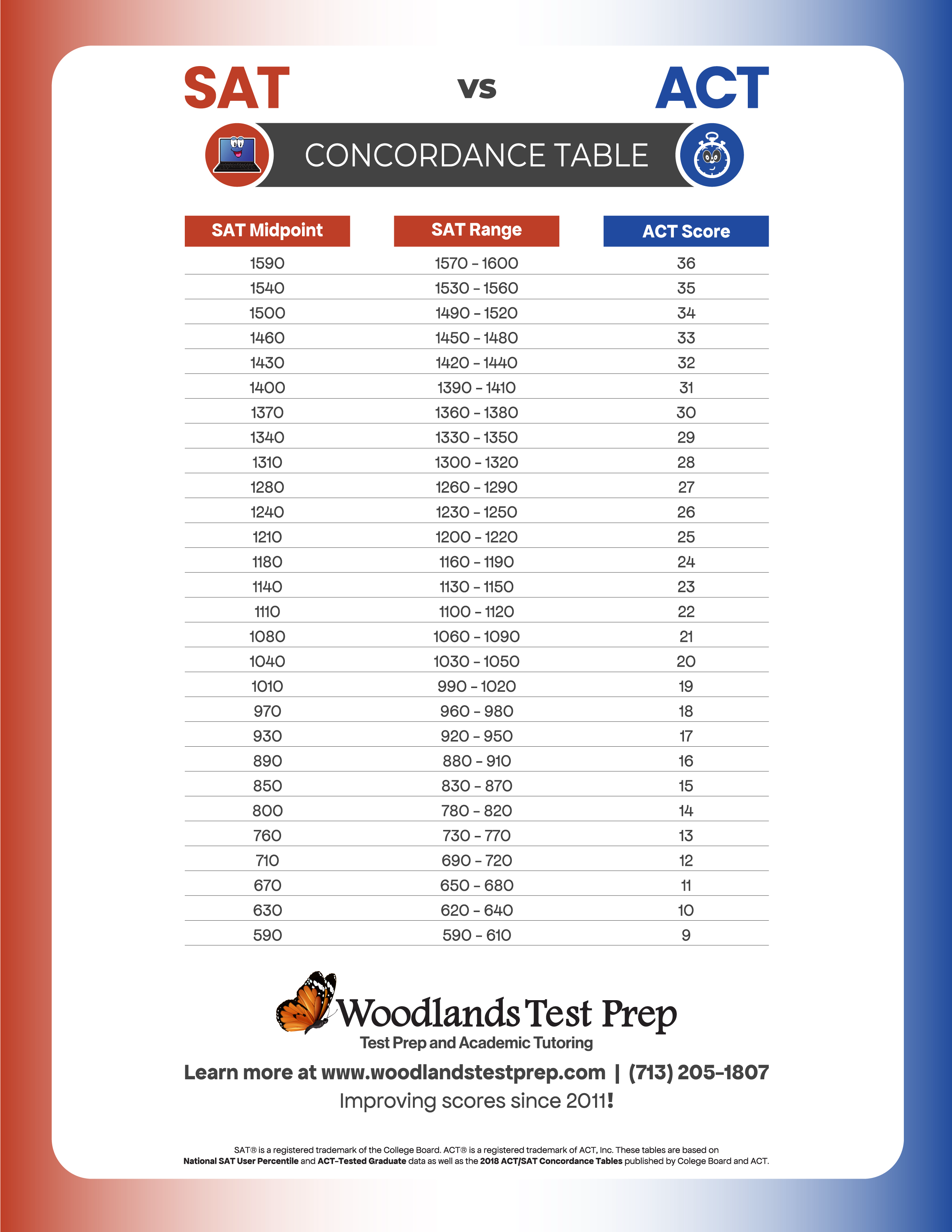
  • You should prep only for the test that suits you best. Most students do better on one test or the other. You can figure out which one is better for you by taking a practice ACT and then comparing it to your PSAT or SAT results. Use our handy comparison tables (below) to compare your results.
  • Each test has a different feel. The ACT is on paper (or should be) and is more straightforward, but much more quickly paced. The Digital SAT is on a computer, gives significantly more time per question, but it’s wordier and uses more complex vocabulary. The ACT tests all types of math; whereas the SAT focuses primarily on Algebra. The SAT gives all students access to Desmos – a built-in graphing calculator; it’s a game-changer! The ACT includes an optional Science Reasoning section which tests data analysis skills more thoroughly than those skills are tested on the SAT.  The Science section does NOT count for your composite score. Pick the test that aligns best with your personal style and gives you the highest score on the concordance table (below).

Use these tips when beginning to formulate your testing plan. Creating a testing strategy helps to maximize your results and remove stress from the process. Woodlands Test Prep can help!  Call us at 713.205.1807 today for a free 30-minute consultation on your test prep strategy. 

And click here for our in-depth discussion of PSAT scores and National Merit considerations.

Your Journey to College: Foundations that Matter

Daily Notes From the Author Inspiration Tests

When families think about college admissions, test scores often feel like the whole story. In reality, those scores are just reflections of something more manageable: steady growth in core skills over time.

In math, that journey starts with pre-algebra basics like mean, median, percents, and proportions. These are concrete skills that can be practiced bit by bit, in classwork, homework, and everyday life (think tips, discounts, and data in the news). By Algebra I, students build on that foundation with algebraic manipulation, lines and slopes, linear systems, and quadratics, turning numbers into patterns they can recognize and use. Geometry and Algebra II then layer on concepts like area and circumference of circles, similar triangles, trigonometry (SOHCAHTOA), and different forms of parabolas.

Language arts grows just as gradually. Identifying complete sentences, punctuating correctly, paraphrasing, and learning new vocabulary are all daily habits that strengthen reading and writing. Later, recognizing subjects and verbs, ensuring subject-verb agreement, and summarizing a paragraph’s main point make complex passages clearer and less intimidating.

Each of these milestones is specific, teachable, and absolutely doable. Focus on one step at a time, and trust that these small wins are quietly building your path to college success. 🏆

MathLanguage Arts
Pre-Algebra✅Mean
✅Median
✅Percents
✅Proportions
✅Identify complete sentence
✅Punctuate sentence
✅Paraphrase sentence
✅Acquire vocabulary
✅Identify & understand transitions
9th Grade
Algebra I✅Algebraic manipulation
✅Lines / slopes
✅Linear systems & solutions
✅Function nomenclature
✅ax2+bx+c
🎯All of the above
✅Identify subject and verb
✅Subject-verb agreement
✅Summarize main point of paragraph
10th Grade
Geometry✅Area/circumference of circle
✅Similar triangles
✅Arcs/sectors
✅SOHCAHTOA
Algebra II✅3 forms of parabola
✅Quadratic solutions
The Great Test Score Comeback: Many Colleges Are Reinstating Standardized Testing

The Great Test Score Comeback: Many Colleges Are Reinstating Standardized Testing

From the Author News Tests Uncategorized

Updated February 20, 2025

After a brief hiatus during the pandemic, many colleges are reinstating standardized test requirements for admissions, and the reason lies in a surprising twist: equity.

Colleges are discovering and reporting that standardized tests actually help level the playing field among students. Research suggests that test scores are a more reliable predictor of college success than high school grades, which have been subject to inflation and vary widely in rigor. By reinstating test requirements, colleges aim to identify talented students from all backgrounds who might otherwise be overlooked.

For instance, UT Austin and MIT both recently reported that they have found that standardized tests help them better predict student success and ensure that students are placed in majors that fit their strengths. Similarly, Harvard and Dartmouth have cited research showing that test scores can highlight the potential of students from under-resourced schools, providing a clearer picture of their academic abilities.

While some institutions never wavered in their requirement for standardized testing, notably University of Florida, a slew of colleges and universities have rejoined the test-required ranks in the past two years:

  • University of Texas at Austin (UT Austin)
  • Harvard University
  • Stanford University
  • California Institute of Technology (Caltech)
  • Brown University
  • Yale University
  • Dartmouth College
  • Purdue University
  • Georgetown University
  • Massachusetts Institute of Technology (MIT)
  • Georgia Institute of Technology (Georgia Tech)
  • Johns Hopkins University (announced 8/20/24)
  • Carnegie Mellon University (announced 8/29/24)
  • University of Miami (announced 1/17/25)
  • Penn State (announced 2/14/25)
  • Ohio State University (announced 3/22/2025)
  • Princeton University (announced 10/9/2025)
  • University of Alabama System (announced 12/18/2025)

Test optional will remain the policy at some colleges and universities, but as you or your student approach your sophomore and junior years in high school, it makes sense to consider how you want to prepare for either the SAT or ACT.  If you’d like help thinking through a plan that makes the most of your strengths and is suited to your college admissions’ goals and schedule, Woodlands Test Prep would be delighted to help!

Why You Should Only Take the ACT on Paper

Why You Should Only Take the ACT on Paper

Uncategorized

Should You Take the ACT on Paper or Digital? Here’s What to Consider

Revised November 19th, 2025

The ACT now offers a choice between paper and pencil and digital formats. With both formats available, many students wonder which format is best. While (starting in September) the content, timing, and scoring are identical, the test-taking experience can feel quite different. Here’s a breakdown to help you decide.

Familiarity and Comfort

Many students still prefer the paper ACT simply because it feels more familiar. You can write directly in the test booklet, underline key phrases, and easily look between passages and questions. For math and science, having the problem right in front of you – and being able to jot notes or calculations in the margins – makes a big difference!

Digital Tools and Navigation

The digital ACT does offer some handy features, like a built-in timer, highlighter/annotator, and answer-eliminator tools. Highlights and annotations, however, are cleared after every question! 😳 Since all passages have multiple questions, that’s a REAL handicap. Also, students find scrolling between questions and long passages to be less intuitive and more difficult than being able to see all of it at one time. On the digital test, you must use scratch paper for any calculations, which means constantly looking back and forth between the screen and your notes (and leaving lots of room for introducing errors).

Technical Issues and Real-World Examples

While the digital ACT is designed for test security, there’s always a risk of technical issues. Some students who signed up for and prepped to take the digital ACT for the recent April 2025 administration were told the day before the test date that they would have to take the paper version instead because their test center couldn’t host the digital version after all. 😳 In another recent situation, a computer glitch prevented 300 students’ digital ACT scores from uploading, forcing many seniors to scramble for a retake. 😳😳 WiFi problems and laggy computers can also eat up precious time and add stress on test day. Students often find that school-issued Chromebooks with small screens make it harder to navigate the test smoothly.

Limited Practice Materials

Currently, there are only two official digital practice tests available, making it tough to prepare in the exact format you’ll face on test day. In contrast, there are plenty of paper practice tests, which can help you build confidence and familiarity.

Score Comparability

Both versions are scored the same way, and colleges don’t prefer one over the other. However, the digital ACT appears to have a harsher score curve, in some cases up to four questions tougher than the paper version on identical tests! 😳

EDIT November 2025: Now that our team took the October 2025 ACT, and we’ve had a chance to compare the scoring scales between the paper test and the digital test, we can say FOR SURE that the digital scales are harsher. Given the obstacles that the digital test presents for English, reading, and science (and math really too!), you would think that the scales would be more forgiving on the digital version, but NO! Tester beware!

Final Thoughts

Given the inherent challenges with the digital platform and the lack of official practice materials, we advise all students to continue to test on paper only. Please let us know all your questions about choosing which version of the ACT as well as whether the SAT or ACT is a better fit overall!

Is the new enhanced ACT a better fit for me?

Is the new enhanced ACT a better fit for me?

From the Author SAT vs. ACT

Now that our team has immersed ourselves in all things enhanced ACT (taken the October ACT, gotten our scores back to calibrate our experiences, become an official ACT affiliate, and deeply analyzed all 33 affiliate test forms and all 6 enhanced ACT forms), we’re VERY excited about the potential for students on the ACT.

In particular, we feel that three groups of students will likely benefit from taking the ACT: students with extended time, students scoring 1000 or below on the PSAT/SAT, students wanting a perfect or nearly perfect score.

Students with extended time: It has always been true that students with extended time have leaned toward the ACT but with the new enhanced ACT and its more relaxed standard timing (compared to the old version), extended time students are very likely to find the ACT a better fit, both at the mock baseline moment but also in terms of how much prep can improve their scores.  The ACT is so much more straightforward, and its reading level is so much lower than the SAT that once the timing constraint is eased, the ACT is almost always a better fit.

Students scoring below 1000 on PSAT/SAT: When students are scoring in this range, they frequently have content gaps.  Because the SAT is so verbal heavy (even the math section is made difficult not by the math tested but by the way questions are phrased) and because underlying verbal skills (paraphrasing sentences or paragraphs and vocabulary core knowledge) take a long time and a lot of effort to improve, students in this score range will often find that they can improve much further on the ACT which doesn’t present those obstacles.

Students looking for a perfect or nearly perfect score: While a student can only miss zero to one question on the SAT to get a perfect score, they can miss significantly more on the ACT and still get a perfect score.  Now that the ACT has significantly fewer questions, the advantage is even bigger.  For example, on Form J08 (the October 2025 test), a student could have missed 4 questions and still gotten a composite score of 36.  At the top end of the scale, the fact of being a human who is bound to make a mistake somewhere looms much larger.

Want to see how you would do on the ACT? We can help! Contact us today!


Tutoring Team & the October 18th ACT

Tutoring Team & the October 18th ACT

From the Author Inspiration SAT vs. ACT

We believe in something simple: You deserve tutors who don’t just know the ACT — but can prove it.

So our whole team takes the ACT regularly to stay sharp and to adjust our strategies based on what’s actually happening on the test right now.

This isn’t theory. This is lived, tested, and practiced knowledge.

October 18 Results:

Susan Powers E35 / M34 / R36 / S36 – composite 35

Tutor 1 – E35 / M30 / R36 / S(NA) – composite 34

Tutor 2 – E27 / M34 / R36 / S32 – composite 32

Tutor 3 – E36 / M35 / R36 / S35 – composite 36 🎉

Tutor 4 – E36 / M35 / R36 / S33 – composite 36 🎉

We’re proud of these scores — and even prouder of how we use what we learn to help our students grow!

Load more

No more posts to load.

Load more

No more posts to load.